


Where to find the freshest crab sandwiches on the quayside
Follow local fishing boats to harbour stalls where brown crab is picked daily and served simply with lemon and brown bread.

Follow the boats, not the billboards
The best crab sandwich in Britain is almost never where you'd expect it. Not in the glass-fronted restaurant with the laminated menu and the photographs of food, and not in the seafront café with the bunting and the piped sea shanties. It's a few hundred yards away, at a folding table on the quay, beside a stack of plastic crates and a man in oilskins who was on the water at five that morning.
The rule is simple. The shorter the distance between the boat and the bread, the better the sandwich. Everything else — the view, the garnish, the price — is decoration.
How to spot a proper crab stall
Not every quayside table is the real thing. A few things give it away:
- Boats within sight. A landing slip, a row of potters, or a harbour board showing landings that morning.
- A blackboard, not a menu. Handwritten prices, today's date, and the word "picked" somewhere on it.
- Brown bread. Or a plain crusty roll. If they're offering ciabatta and a crab brioche, walk on politely.
- Brown and white meat, separated. A good stall sells tubs of each, or asks which you'd prefer.
- A short day. Open at nine or ten, sold out by two or three. If it's five in the afternoon and the tray is still full, ask yourself where that crab has been.
Card machines are common enough now, but keep a tenner on you. Small stalls in small harbours are still small businesses.
Brown crab, and how to judge it
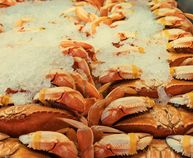
The crab in your sandwich is almost certainly brown crab, the heavy, dark-clawed brute that turns up in pots all round the British coast. Its white meat comes from the claws and legs: sweet, fibrous, faintly saline. The brown meat sits inside the carapace: soft, rich, deeply savoury, and in my view the better half.
Freshness is easy to read. White meat should pull apart in clean strands and taste of the sea, never of the fridge. It should not be claggy or pasty, and it should not smell in the least of ammonia — that's the point of no return. Ask when it was picked. A good stallholder will tell you not just the day but the boat.
Brown crab is at its fullest from late spring through to autumn, and inshore boats often keep the stalls going at weekends through the winter. Late summer, after the moult, is when the shells are hardest and the meat densest.
Harbours worth the detour
Every fishing harbour has its own version of the same pleasure. A few where the boat-to-bench gap is pleasingly narrow:
- Cromer, Norfolk. The most famous crab in England, and one of the sweetest — the local stock is smaller and finer-flavoured than most.
- Whitby, North Yorkshire. A working harbour with a smokehouse smell in the air and stalls on the quay below the abbey steps.
- Newlyn and Mevagissey, Cornwall. Newlyn is a serious commercial port; Mevagissey is prettier and busier for it.
- Brixham, Devon. One of England's largest fishing ports, with a proper market and a healthy disregard for tourism.
- Crail, Anstruther and Pittenweem, Fife. The East Neuk string of harbours, where crab comes ashore in small boats and the sheds are still in use.
- Oban and Mallaig, Scotland. Ferry ports as much as fishing towns, with crab, prawns and langoustines landed daily.
- Beaumaris and Moelfre, Anglesey. Smaller and quieter, and all the better for it in July.
Wherever you go, the pattern holds. Find the harbour, find the ice house or the fish shed, and look for the table nearest the water.
Maritime heritage you can still smell
Half the pleasure of eating on the quay is that the trade is still visible. Look for the old net lofts, now studios and chandlers, with their wide doors opening onto the harbour. Look for the lifeboat station and the slipway worn smooth by decades of launches. In Scotland and the north-east, the herring years left long, narrow sheds and the memory of the fisher lassies who gutted and packed fish at astonishing speed.
Many harbours still keep an ice house, or a smokehouse working much as it did a century ago. Ask about them. Harbour towns are proud of their history and generally delighted to talk, particularly if you've bought something.
Sitting on the wall
Timing matters. Boats land early and the tray is filled mid-morning, so aim for eleven and you'll get the pick of the meat plus, with luck, a place on the wall. Arrive at two on a Bank Holiday Saturday and you'll queue for a sandwich made from yesterday's crab. If you've sailed in, check the tide: harbour gates, sills and drying berths all have their own rules, and a visitor pontoon that looks inviting at high water may be a mudbank by evening. Regatta weekends are wonderful and appalling in equal measure — full harbours, loud bars, every sandwich gone by noon.
And eat it properly. Brown bread and butter, a wedge of lemon, a twist of black pepper. Perhaps a little salt, perhaps a drop of vinegar if the stall offers it. No mayonnaise, no salad leaves, no crisps crushed on top. Sit on the harbour wall with your feet over the water, in the smell of rope, diesel and weed, and let the boats do the talking.

Post a comment